Skip to content
Web-App · Eigenprodukt

PriceMatters: Basic prices instead of confusion

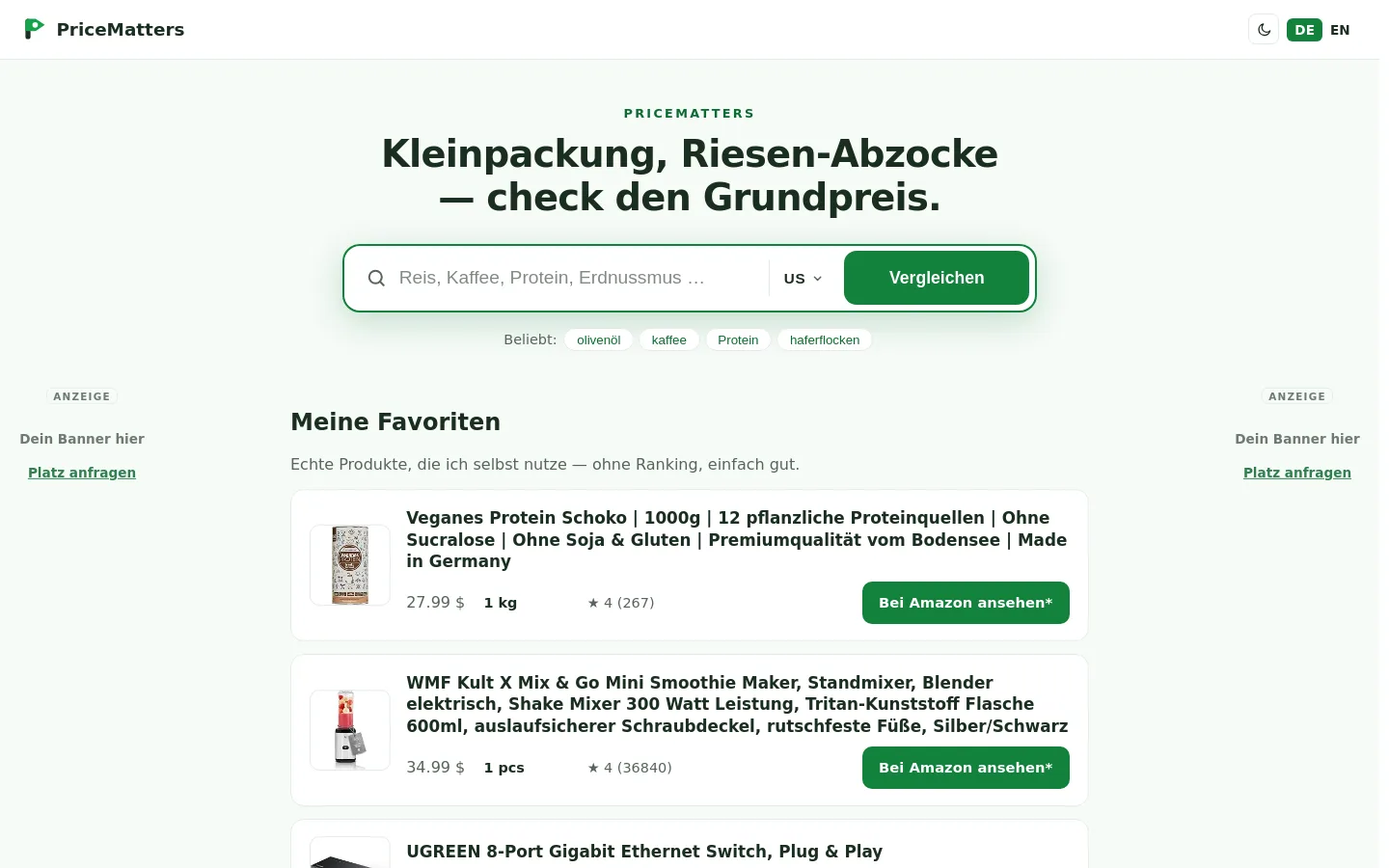
A price comparison that does not show the package price, but the price per kilogram, liter or piece - including price alerts.

Client
Websters own product
Art
Web-App · 2026
Technology
Nuxt · FastAPI · PostgreSQL · Redis
PriceMatters – price comparison with basic prices per kilogram and liter
Initial situation

What was the problem

Supermarket prices are difficult to compare as soon as pack sizes and brands change. 500 g costs less than 1 kg - but which product is really cheaper?

Existing price comparison sites usually only show the total price. The actual comparison value – price per kilogram, liter or piece – is missing or hidden.

A simple calculation example: 500 g for €2.79 corresponds to €5.58 per kilogram, 1 kg for €4.99 corresponds to €4.99 per kilogram. The package price alone is misleading - this is exactly the gap PriceMatters is supposed to close.

Solution

What we have built

PriceMatters normalizes product data and automatically calculates the base price. Users can see at a glance which product is cheaper per unit.

There are also price alerts: a product can be monitored without having to check it yourself every day. The application is built as a fast, responsive web app - not as an overloaded comparison portal construction kit.

The most important functions

Not every function makes sense for every project. These solve specific tasks.

  • Search and filter by products, categories and basic price
  • Automatic calculation of €/kg, €/L and €/piece
  • Traceable conversion of different quantities and units
  • Price alerts for monitored products
  • Responsive interface for desktop and smartphone
  • Separate API and frontend for fast iteration

Why these decisions?

Warum Nuxt?

Server-side rendering and a clear component structure – good for discoverable product pages and fast interactions.

Warum FastAPI?

The data preparation and pricing logic can be mapped clearly and testably in Python.

Why PostgreSQL and Redis?

PostgreSQL for structured product and price data, Redis for fast caching of recurring queries.

Why its own normalization?

Pack sizes and units vary. The application converts them to a common basis before comparing - otherwise the basic price would just be another number without any meaning.

What became of it

Honestly classified: What the project shows - and what we consciously do not claim.

PriceMatters is live and publicly available. The project shows how we implement product ideas from data models to APIs to interfaces - including operations.

It is not a customer project with external conversion numbers. That's why we deliberately don't mention any fictitious sales or traffic values.

Transparency: We only publish facts that are demonstrable: no invented customer votes, no guaranteed rankings and no glossed metrics.

What you can take away from it

  • Clear data normalization is more important than an elaborate design when comparing prices.
  • Keeping the API and frontend separate makes later extensions and alternative clients easier.
  • A price comparison is only as good as its normalization: only when the quantity and unit are correct does a package price become a fair comparison.
  • Our own product is an honest test of our own quality standards - no one sugarcoats the problems for us.

Questions about this project

No. PriceMatters is a proprietary product of Websters. We took over the idea, design, development and operation ourselves.

Yes. We develop comparable web apps with individual data logic, interfaces, roles and operation - from €3,490 for a clearly defined scope.

Nuxt for the frontend, FastAPI for the API, PostgreSQL for the data and Redis for fast caching. The technology is selected for customer projects based on requirements.

Fits these services

Do you want to implement something similar? These pages show the appropriate framework, the prices and the process.

A similar project in mind?

Tell us briefly what you want to build. You will receive an honest assessment, a rough schedule and a price range - free of charge and without obligation.